
The Community Care Pledge
Notice. Ask. Stay. Connect.
A shared commitment for teachers, first responders and neighbors to recognize mental health struggles and respond with compassion, during a crisis and long after it.
U.S. adults lived with a mental illness in 2022 (NIMH: Mental Illness Statistics).
U.S. high school students felt persistently sad or hopeless in 2023 (CDC: Adolescent and School Mental Health).
of first responders are estimated to develop behavioral health conditions such as depression and PTSD (SAMHSA: First Responders Behavioral Health Bulletin (2018)).
The pledge
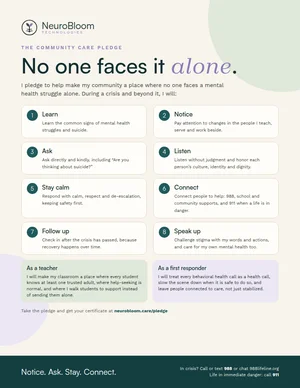
I pledge to help make my community a place where no one faces a mental health struggle alone. During a crisis and beyond it, I will:
- 01
Learn
Learn the common signs of mental health struggles and suicide.
- 02
Notice
Pay attention to changes in the people I teach, serve and work beside.
- 03
Ask
Ask directly and kindly, including “Are you thinking about suicide?”
- 04
Listen
Listen without judgment and honor each person’s culture, identity and dignity.
- 05
Stay calm
Respond with calm, respect and de-escalation, keeping safety first.
- 06
Connect
Connect people to help: 988, school and community supports, and 911 when a life is in danger.
- 07
Follow up
Check in after the crisis has passed, because recovery happens over time.
- 08
Speak up
Challenge stigma with my words and actions, and care for my own mental health too.
I will make my classroom a place where every student knows at least one trusted adult, where help-seeking is normal, and where I walk students to support instead of sending them alone.
I will treat every behavioral health call as a health call, slow the scene down when it is safe to do so, and leave people connected to care, not just stabilized.
Take the pledge
Add your name. Share your commitment.
Sign below to create your personal Community Care Pledge certificate and a badge you can share with your school, department and neighbors.
Organization toolkit
Bring the pledge to your school, station or community.
Everything you need to launch the pledge with your team, from a printable poster to social graphics and training.
Introduce it
Share the pledge at a staff meeting, roll call or community event. Display the poster in break rooms and hallways.
Invite signatures
Send this page to your team. Each person signs and downloads a certificate and share badge.
Build the skills
Pair the pledge with the Community Care Academy: ten 45-minute courses for $299 per learner.
Keep it going
Revisit the pledge each semester or quarter. Celebrate examples of noticing, asking and following up.
Why "beyond the crisis"
Recovery happens over time, and so does community.
Most crises are resolved through calm conversation and connection rather than emergency intervention (SAMHSA: 988 Frequently Asked Questions). Research also suggests that caring follow-up after a crisis is associated with lower suicide risk (#BeThe1To: The 5 Steps and Evidence). The pledge asks each of us to show up in the moment, and to keep showing up afterward.
The Community Care Pledge is a voluntary commitment to awareness and compassionate action. It is not a certification or clinical training, and it does not replace agency policy, mandated reporting duties or emergency services.